
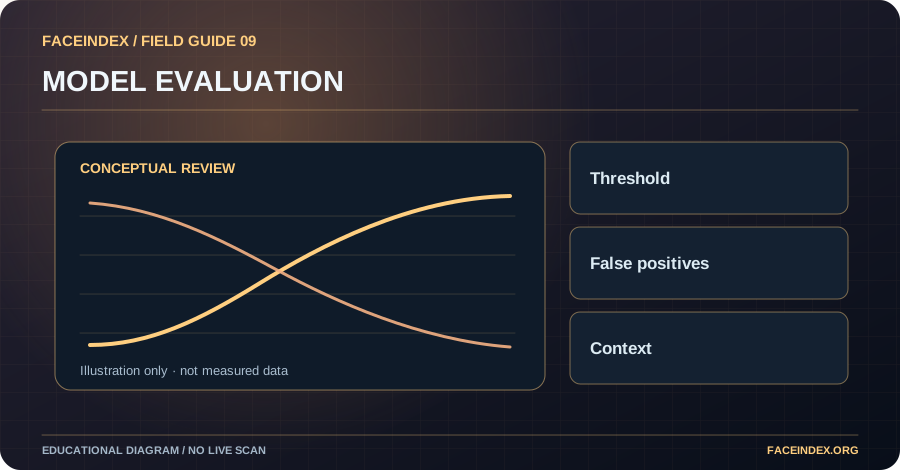
There is no universal accuracy rate for porn facial recognition. Reliability varies by task, testing population, image quality and system configuration. A similarity score cannot justify identifying a person in intimate material or making claims about their private conduct.
Ask what accuracy is measuring
A system can be evaluated on whether it retrieves relevant images, whether it accepts correct comparisons or how often it incorrectly accepts different subjects. These are distinct measures. A marketing percentage without a specified dataset, task and evaluation protocol is not a meaningful comparison.
Understand trade-offs conceptually
In biometric evaluation, changing a decision threshold can trade one type of error against another. A stricter criterion may reject more correct comparisons, while a more permissive one may accept more incorrect ones. This is a general statistical observation, not guidance for identifying individuals in intimate imagery.
Why population and collection matter
A test on one controlled group of images may not generalize to another. Image conditions, model differences and the number of candidate comparisons can change observed performance. Evaluations should consider both errors and the uncertainty of the reported measures. A single score has no universal interpretation across providers.
Use the evidence within its limits
For unauthorized image reuse, the relevant question may be whether an image matches a work you own rather than who appears in it. If the concern involves intimate harm, use appropriate privacy or copyright reporting processes. Do not use a similarity result to accuse or identify a person.
Step-by-step action checklist
- Read the provider's definition of the measured task.
- Look for the dataset, testing conditions and error measures.
- Avoid interpreting similarity scores as probabilities of identity.
- Keep sensitive identity claims outside the scope of visual checks.
What responsible action looks like
An illustrative model is tested on fictional patterns and returns several incorrect candidates. A score by itself does not explain the error unless the evaluation task and conditions are known.
Is a 90% similarity score a 90% chance two people are the same?
Not necessarily. Scores are model-specific and may not be calibrated probabilities. They do not establish identity.