
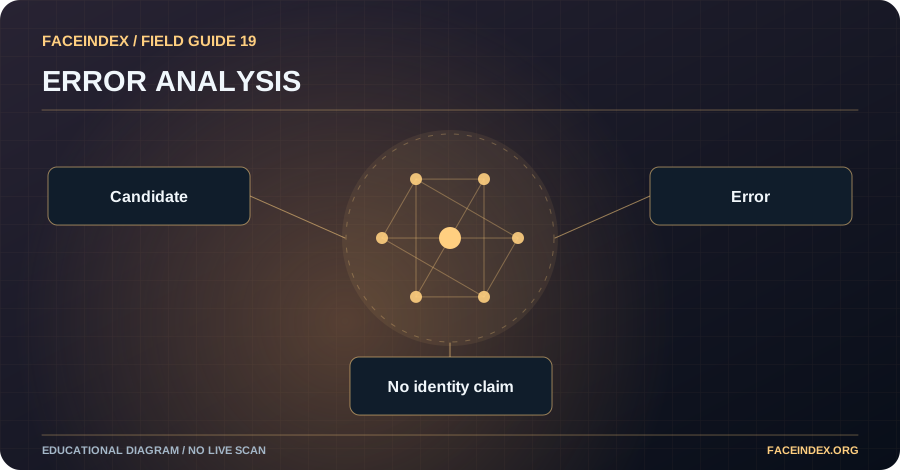
A false positive is a reported match that is incorrect under the evaluation's definition. Image conditions, data and model limitations can affect errors. Because mistaken intimate-image identification can cause serious harm, do not draw identity or conduct conclusions from facial similarity.
Why a match can be wrong
Visual representations compress complex information into features. Different inputs can be close in that representation, even when the underlying subjects differ. The system's output should therefore be understood as a candidate or score rather than a verified assertion. A match can also reflect an altered image, repeated background or other shared visual characteristics.
The difference between detection and attribution
A detector may recognize a region that appears to be a face. A comparison system may report similarity between two regions. Neither of those results independently establishes a person's real-world identity. Attributing an intimate picture to a real person requires evidence beyond algorithmic resemblance; do not attempt such identification using these tools.
Use error terminology precisely
Evaluators describe false acceptances, false rejections and retrieval errors in different settings. A system's performance depends on the defined task and conditions. An illustrative error example can teach why results need caution without exposing or naming actual people.
Avoid turning an uncertain result into harm
Do not publish an alleged identity, contact a supposed match or make claims about private behavior based on a score. For your own copyright or privacy incident, focus on the work, the location of unauthorized material and the corresponding report process. Record uncertainty rather than treating it as a conclusion.
Step-by-step action checklist
- Distinguish the tool's task from a real-world claim.
- Ask what an incorrect result means in its evaluation.
- Do not attach names or intimate-activity claims to scores.
- For content protection, rely on known ownership and report evidence.
What responsible action looks like
Two generated abstract portraits have similar feature patterns in an educational illustration. A model could group them together, but the exercise provides no basis to name a person or claim an occurrence in intimate content.
Would a higher similarity value eliminate false positives?
No. All comparisons have limitations, and the score alone cannot establish identity. Avoid using intimate-image matches to identify someone.