
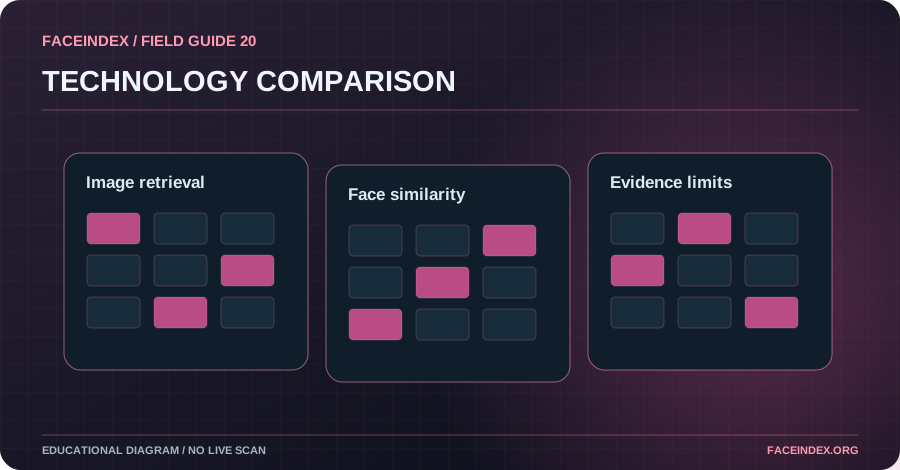
Reverse image retrieval compares visual content, while facial matching compares features associated with faces. Those tasks produce different types of candidate results. Neither establishes consent or private behavior, and facial matching should not be used to identify nonconsenting people in intimate imagery.
Whole-image retrieval
An image retrieval system may attempt to surface exact or visually similar pictures. Depending on the system, it may respond to changes in cropping, compression or other image properties. For creator-owned work, this can be understood as a question about correspondence between creative materials, subject to the tool's coverage and limitations.
Facial similarity
A facial matching system focuses on numerical representations of facial appearance. That may be useful in appropriate consented, non-intimate research contexts, but results are uncertain and can be misinterpreted. A facial score is not a legal identification, authenticity judgment or proof that a person engaged in an activity.
Compare methods by the legitimate task
If a creator is reviewing unauthorized reuse of an original work, relevant records include the original and suspected copy, publication rights and the known location of misuse. The identity of a person depicted is not necessary to prepare a copyright report. For nonconsensual content, focus on privacy and platform reporting.
Think about data handling before selecting a tool
Image search and facial comparison can both involve processing sensitive inputs. Review upload terms and consider local or non-intimate alternatives. Do not use an unfamiliar service to expose private material merely to test its features. Choose the method that minimizes disclosure and fits the purpose.
Step-by-step action checklist
- Define whether the issue is image reuse, privacy or education.
- Understand what the comparison system actually measures.
- Use authorized non-intimate references where a search is appropriate.
- Base reporting decisions on verified facts, not resemblance.
What responsible action looks like
A creator has a known unauthorized repost of their own artwork. The creator's useful comparison is between the original and the copy, together with ownership records, rather than identification of anyone shown in the material.
Is facial recognition always better than image search?
No. They address different tasks and have different error profiles. Neither proves consent, identity in an intimate context or copyright infringement.