
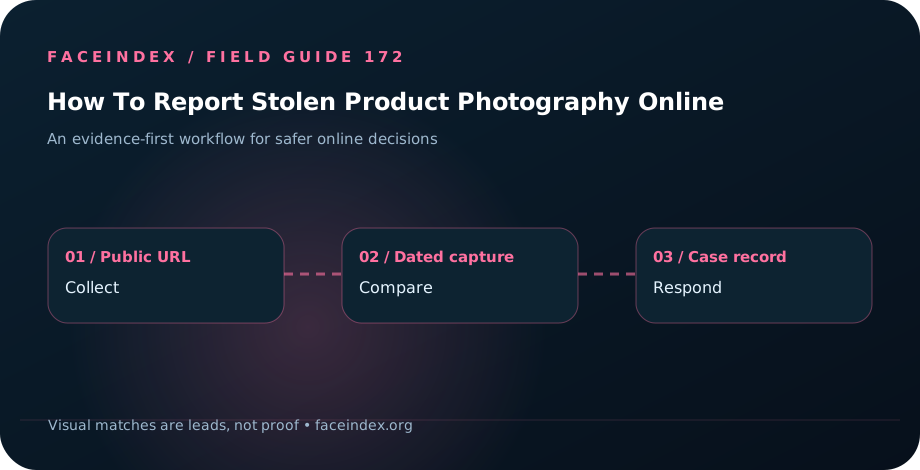
Prepare a report reviewers can act on
Begin with record the public URL, platform username, screen capture, date, and the report category that matches the harm. Then document the image source, alternate crops, and public page context before taking action.
Choose the official category whose evidence requirements you can actually satisfy. A privacy or impersonation complaint is not interchangeable with a copyright notice.
Keep a copy of the report ID and response; if rejected, revise the evidence or review the official appeal instructions before sending duplicates.
What to save for photo reuse
The key distinction for this question
Product photos reused by a fraudulent shop can implicate copyright and consumer fraud; document both without conflating them. The practical outcome is an evidence file you could explain to an independent reviewer—what was visible, what you checked, and what is still uncertain.
For “how to report stolen product photography online,” the most useful distinction is the difference between public evidence and a conclusion about a person. If the situation concerns fraud, preserve the suspicious messages as well as the images. If it concerns privacy or rights, preserve the original source and the disputed public URL separately.
Understanding how to report stolen product photography online
A friend forwards you a public link related to online image. Instead of treating the visual resemblance as a verdict, you compare dates, linked accounts, and the image source, alternate crops, and public page context with information published independently.
Visual matches are research leads, not proof of consent or wrongdoing. The point is to test the underlying claim about the online image with evidence that would make sense to an independent reviewer.
What should happen next?
You own the copyright
Use the host’s copyright reporting path with a clear identification of the original work and disputed URL.
You are depicted but not the creator
Consider privacy, impersonation, or applicable likeness protections instead of asserting ownership you may not have.
A request is rejected
Preserve the response, review appeal instructions, and consider advice from qualified legal support.
How FaceIndex fits into the picture
A public visual match may help you find another appearance of an image, but it does not establish identity, consent, fraud, ownership, or that a photo is AI-generated. Read the destination page and compare the surrounding facts.
For this rights review, preserve the original file, licensing terms if any, creator identity, and the copied location. Keep matches separated into exact duplicates, altered versions, lookalikes, and unrelated pages.
Where to get reliable guidance
Use official documentation and reporting channels rather than copied advice from third-party posts. These resources explain relevant protections and limitations; availability and eligibility depend on the situation.
FaceIndex is independent of these organizations. These links are educational references, not endorsements or a promise that your specific request will be approved.
Questions to consider
What is the safest first step for how to report stolen product photography online?
Begin with record the public URL, platform username, screen capture, date, and the report category that matches the harm. Then document the image source, alternate crops, and public page context before taking action.
What if a face search returns a match related to photo reuse?
Check the hosting page and surrounding public facts. Visual matches are research leads, not proof of consent or wrongdoing. A result can be a useful starting point without identifying the individual behind an account.
What if the available evidence is uncertain?
Do not publish accusations. Preserve the image source, alternate crops, and public page context, continue verifying through trusted sources, and use official reporting channels only for claims you can support.
Keep learning with nearby FaceIndex guides
We are here to help people protect themselves online
FaceIndex exists to add clarity to a serious internet problem. Start with a free search, review public evidence carefully, and choose the safest next step for your situation.