
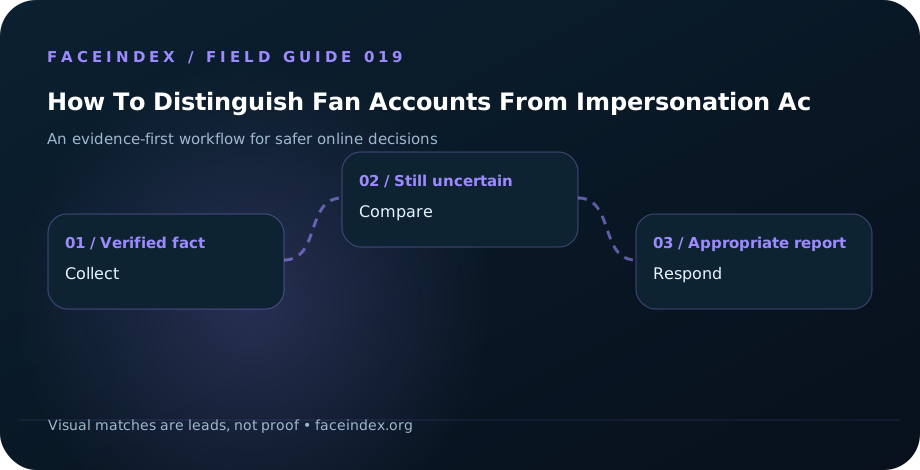
Look for the underlying mechanism
Begin with compare image sources, indexing behavior, editing and duplication patterns before drawing conclusions. Then document the public claims and relevant URLs before taking action.
For this question, focus on the public claims and relevant URLs. Those details usually tell you more than an isolated thumbnail.
Write down what you know about the public content and what remains unverified. That separation is useful whether you search, report, or choose not to engage.
Understanding how to distinguish fan accounts from impersonation accounts
A search result connected to public content looks troubling. Before you report it, you distinguish what the image literally shows from what the caption implies, and preserve the original page and timestamp.
Review each apparent match independently. The point is to test the underlying claim about the public content with evidence that would make sense to an independent reviewer.
What should happen next?
A credible mismatch appears
Preserve public claims and relevant URLs, then report the public content through the platform or hosting provider using the most relevant category.
The evidence is incomplete
Continue comparing source pages and dates. Use explanation cautiously; a visually similar face is a lead, not proof.
Someone is at immediate risk
Stop payments and account access, use trusted support channels, and prioritize safety. Do not send more personal information.
What to save for public online identity
The key distinction for this question
Fan commentary and tribute accounts differ from deceptive accounts claiming to be the creator; focus reports on actual misleading representations. The practical outcome is an evidence file you could explain to an independent reviewer—what was visible, what you checked, and what is still uncertain.
For “how to distinguish fan accounts from impersonation accounts,” the most useful distinction is the difference between public evidence and a conclusion about a person. If the situation concerns fraud, preserve the suspicious messages as well as the images. If it concerns privacy or rights, preserve the original source and the disputed public URL separately.
How FaceIndex fits into the picture
A public visual match may help you find another appearance of an image, but it does not establish identity, consent, fraud, ownership, or that a photo is AI-generated. Read the destination page and compare the surrounding facts.
For this creator account, keep a capture of the genuine profile and the copy side-by-side, showing which links are authorized. Keep matches separated into exact duplicates, altered versions, lookalikes, and unrelated pages.
Where to get reliable guidance
Use official documentation and reporting channels rather than copied advice from third-party posts. These resources explain relevant protections and limitations; availability and eligibility depend on the situation.
FaceIndex is independent of these organizations. These links are educational references, not endorsements or a promise that your specific request will be approved.
Questions to consider
What is the safest first step for how to distinguish fan accounts from impersonation accounts?
Begin with compare image sources, indexing behavior, editing and duplication patterns before drawing conclusions. Then document the public claims and relevant URLs before taking action.
What if a face search returns a match related to public online identity?
Check the hosting page and surrounding public facts. Review each apparent match independently. A result can be a useful starting point without identifying the individual behind an account.
What if the available evidence is uncertain?
Do not publish accusations. Preserve the public claims and relevant URLs, continue verifying through trusted sources, and use official reporting channels only for claims you can support.
Keep learning with nearby FaceIndex guides
We are here to help people protect themselves online
FaceIndex exists to add clarity to a serious internet problem. Start with a free search, review public evidence carefully, and choose the safest next step for your situation.